
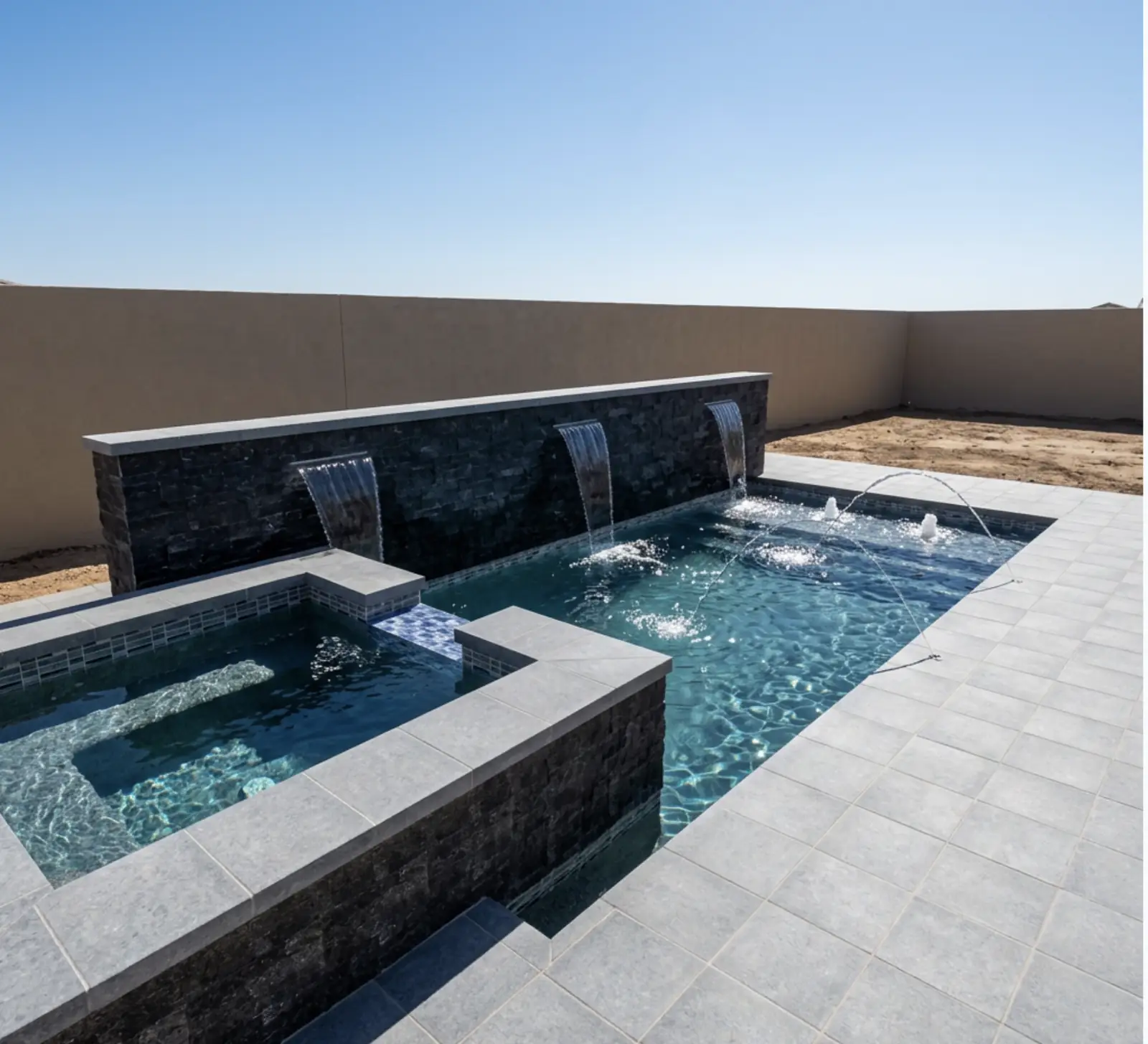
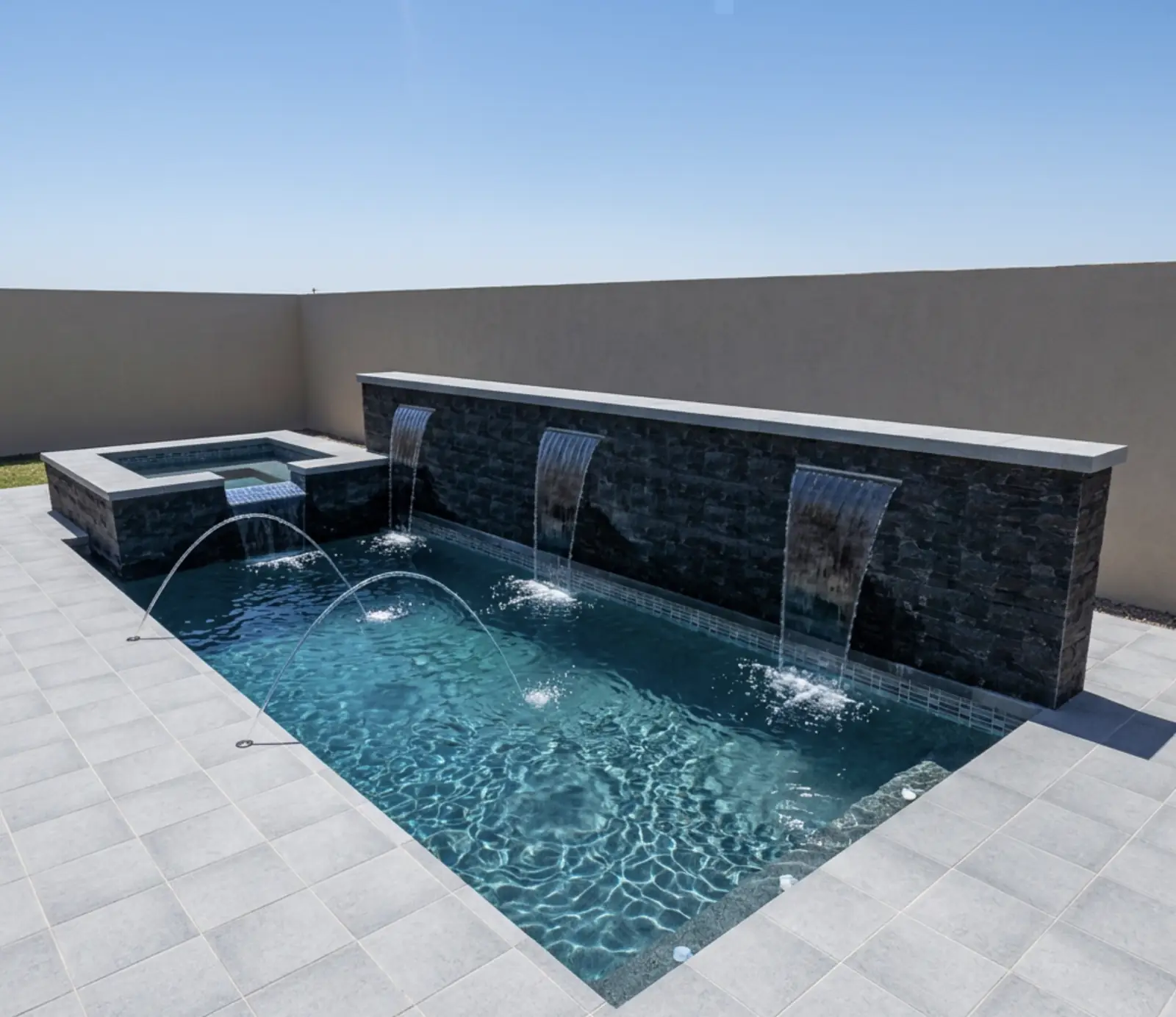
Almost every homeowner who starts researching a pool runs into the same three words: fiberglass, gunite and vinyl. They describe how the pool is built, and that choice affects the shape you can have, how the install goes, what upkeep looks like and how the price is put together.
This guide is written for two readers. If you are a homeowner, it gives you a way to compare the three without getting lost in sales language. If you are a pool builder, it gives you a clear way to explain each option and to show the differences in an online estimate. It stays general on purpose. Exact prices, timelines and product details depend on your builder, your region and the materials chosen, so use this as a map for the questions to ask.
The short version
- Gunite (and shotcrete): a concrete shell sprayed over a steel frame, built on site. It offers the most freedom in shape and size.
- Fiberglass: a pool shell made in a factory from a mold, delivered and set into an excavation. The shape comes from the manufacturer's catalog.
- Vinyl liner: a wall frame filled in with a flexible liner sheet that holds the water. It is the most standardized of the three.
None of these is the right answer for every yard. Region matters too, since builders in some areas mostly build one type and rarely the others. A good builder will tell you which they build and why, and a good estimate will show what each choice adds or removes.
How each pool is built
Gunite and shotcrete
The crew excavates the shape, ties a framework of steel reinforcing bar, and installs plumbing lines. Concrete is then sprayed over the steel to form the shell. After it cures, the interior gets a finish such as plaster, pebble or tile. Because the shell is formed on site, the builder can follow almost any outline, depth profile or built-in feature.
The terms are often used loosely. Both gunite and shotcrete are sprayed concrete, and the difference is mainly in how the mix is handled at the nozzle. Homeowners do not need to master the distinction, but it is fair to ask your builder which method they use.
Fiberglass
A fiberglass pool is built off site in a mold, then trucked to the property. The crew excavates to match the shell, prepares a base, and lifts the shell into place, usually with a crane. Plumbing connects to fittings that are already part of the shell, and the space around it is backfilled.
Because the shell is made ahead of time, much of the work happens in a controlled factory rather than in the backyard. The tradeoff is that you choose from existing models. Size and shape are limited by what the manufacturer offers and by what can be delivered and lifted into your yard.
Vinyl liner
A vinyl pool starts with an excavation and a wall system made of panels. The floor is typically built from a fill material that is shaped and smoothed, and a custom-cut liner sheet is fitted over everything. Water pressure holds the liner against the walls and floor.
Liners are made to fit standard dimensions, which keeps the build straightforward. Shape choices are usually simpler than with gunite, though many pool types are available, and features such as steps and benches come from the manufacturer's options.
Customization: what you can change
This is where the three differ most, and it is a good first filter.
- Gunite: the most flexible. Freeform shapes, custom depths, raised walls, vanishing edges, built-in seating, swim-up areas and attached spas are all possible, subject to engineering and the site.
- Fiberglass: limited to the available molds, though catalogs often include many shapes, built-in steps, benches and tanning ledges. Add-ons such as a spa can be part of a single shell design or added separately.
- Vinyl: typically the narrowest range of shapes, with standard outlines and standard features. Liner patterns give some visual choice.
When a homeowner has a specific idea, like a long narrow lap shape or a pool that wraps around a patio, ask whether the option you are considering can actually do it. A fiberglass shell has to fit through the access path and be lifted over obstacles. A gunite pool does not have that limit, but it needs room for equipment.
The install process
All three begin with design, permits and excavation. After that, the paths split.
- Gunite involves several separate trades and inspections, such as steel, plumbing, spraying the shell, tile and coping, decking and the interior finish. More steps mean more coordination and more points where weather or scheduling can matter.
- Fiberglass has fewer steps on site once the shell is ready, but depends on manufacturing and delivery. The set day is a significant event with heavy equipment.
- Vinyl has a middle path, with a wall system and floor prep before the liner goes in. The liner fitting depends on measurements being accurate.
Homeowners often want to know how long each takes. The honest answer is that it depends on the builder, the city, the season and the project, so ask for a written schedule. For a stage-by-stage view of how a build moves, read how long it takes to build a pool.
Finish and maintenance
The surface that the water touches is a big part of the day-to-day experience.
Gunite finishes
Plaster, pebble and other aggregate finishes are common. They can be textured, and the look ranges from smooth to rugged. These surfaces are porous compared with the others, so water chemistry matters, and the finish will eventually need refreshing. Ask your builder what the finish needs and what a refresh involves.
Fiberglass surfaces
The shell has a smooth gel coat. Many homeowners like the feel and the fact that the surface is less welcoming to algae than rough finishes. Care is still needed, and the gel coat can be damaged by the wrong products or impact, so follow the manufacturer's guidance.
Vinyl liners
The liner is soft underfoot and smooth. It can be punctured or worn, and it is replaced at some point as part of ownership. Ask the builder what warranty applies to the liner and what the replacement process involves.
In every case, the real maintenance picture also includes chemicals, filtration, cleaning and the equipment package. A pool of any type needs regular care, and the builder should walk the homeowner through it.
Lifespan considerations, in general terms
It is tempting to ask which pool lasts longest. A better question is which parts wear out first and what replacing them involves. Each type has a structure and a surface, and they age differently.
- With gunite, the shell is structural concrete, and the interior finish and tile are the parts that tend to need attention over time.
- With fiberglass, the shell and its surface are one piece, so the focus is on the condition of the gel coat and the ground behind the shell.
- With vinyl, the liner is the replaceable layer, and the wall system and base are the parts to keep sound.
Soil, groundwater, water chemistry, climate, installation quality and care all play a role. Get warranty terms in writing for each pool type, and ask what they cover and what they exclude.
How pricing differs, qualitatively
This post does not quote prices, because they vary by region, lot, materials and builder. What can be said is how the cost is built.
- Gunite: cost is driven by site labor, steel, concrete, the interior finish, tile and the many options a custom shape allows. More customization generally means a larger swing in price.
- Fiberglass: cost includes the manufactured shell, delivery, crane time and the excavation and backfill. Choices are narrower, so the price range for a given model is often tighter.
- Vinyl: the structure is more standardized, which often keeps the starting point lower, while long-term costs include liner replacement and any upgrades to features.
The point for homeowners is to compare total ownership, not just the first number. A lower starting point can come with later costs, and a higher one can include features you would otherwise add. Ask each builder what is and is not included. The guide to pool cost factors shows what moves a price in either direction.
A comparison checklist for homeowners
Use these questions with any builder you talk to, whichever type they build.
- What type of pool do you recommend for my lot, and why?
- Can the shape I want be built with this construction method?
- How would the shell or equipment get into my yard?
- What interior surface do you offer and what does it need?
- What is covered by warranty, and for how long, in writing?
- What does the estimate include and what does it leave out?
- What would change the price after the site visit?
- Who handles permits and inspections?
If a builder only builds one type, that does not make them a bad choice. Ask them to explain how their method fits your goals, and ask what they would do differently if you wanted another type.
How builders can present each option online
Builders who offer more than one type face a practical problem: homeowners compare options before they ever call. If the website only says "we build all types," the homeowner has nothing to compare. A few habits help.
- Explain your approach in plain words. Say which types you build and what each does best. Avoid disparaging the others.
- Show the tradeoffs visually. A simple side by side of shape freedom, install steps and finish upkeep is more useful than a paragraph.
- Use real pricing for each. An estimate for a gunite pool and one for a fiberglass model should each come from your actual numbers for that construction method.
- Itemize. Shell, excavation, plumbing, finish, decking and equipment should be separate lines so the homeowner sees what drives the difference.
- State assumptions. Access, soil and engineering conditions affect all three types, and fiberglass has delivery and crane access to consider.
- Say the estimate is confirmed at the site visit.
If you only build one type, you can still show the comparison in a short section on your site. Homeowners will compare you to the other types anyway, and you are better placed to frame it than a search result is. For more on what to put in front of homeowners early, read what a pool builder should show homeowners before the site visit.
A simple rule for estimates: one estimate should reflect one construction method. If a homeowner wants to compare, show them two estimates side by side, each built from your own pricing for that method, rather than a blended range that fits neither.
Where design tools fit in
A homeowner choosing between types is really choosing between shapes, features and budgets. Seeing a pool on their own lot makes that choice more concrete. A design tool on your website lets them try a layout, pick materials and see the effect on the estimate, which turns an abstract comparison into a real one.
QuickPoolQuote puts a 3D pool design, an instant price and lead capture on your own website. The estimate is built from the builder's own pricing, itemized, and confirmed at the site visit. A lead is a homeowner who completes a design and submits contact info, so you know they have already shaped a project. You can read more about the AI pool designer and how instant pool quote software works.
Plans start at $495 per month, or $4,752 per year with annual billing at 20% off, and include 100 leads per month. Extra leads come in packs of 50 for $199. There is no setup fee, and the tool is live in about 24 hours. See pricing for details.
Mistakes to avoid when comparing
- Comparing quotes that include different things. One may include decking and equipment while another does not. Line them up item by item.
- Choosing on the starting number alone. Ask what is excluded and what it costs to add.
- Assuming the shape does not matter. It affects the construction method, the access and the price.
- Skipping the warranty fine print. What is covered and who honors it matters more than the headline.
- Ignoring the yard. Slope, access, soil and utilities can favor or rule out an option.
Builders can help by being clear about these points early. A homeowner who understands what is behind a number is easier to work with at the visit. The article on pool cost calculators vs pool design software explains why a generic range rarely captures them.
Common questions
Which type is best?
There is no single best type. Gunite suits custom shapes and large or complex projects. Fiberglass suits homeowners who want a ready-made shell and a smooth surface. Vinyl suits those who want a standardized build. Your lot, budget, goals and local builders decide.
Can I get a custom shape in fiberglass?
Fiberglass comes from molds, so you choose from the available models. Some manufacturers offer many shapes and features, but a fully custom outline is a gunite strength.
Do all three need permits?
Permit rules depend on your city and county, and they apply to any pool type. Ask your builder how permits and inspections are handled.
Does the type change the price I will see online?
It can. Each method has its own cost structure, so a good estimate is built from the builder's pricing for that method and itemized so you can see why.
How do I see a price for my own yard?
Many builders now offer a design tool on their website. You can also start by asking for an itemized estimate. If you are a builder who wants this on your site, visit get started, call 480-602-1192, or check the help center. If you need a website to go with it, see the free pool builder website option.
See it on your own website
Pool design software, with a price from your pricing, live in 24 hours.
More from the blog
Put design software on your website this week.
Homeowners who design their pool and see a price call you ready to build. Tiers start at $495 a month with no setup fee. See pricing