
Most pool builders do not have a marketing problem so much as a leak problem. Homeowners find them, look around, and leave without doing anything. Marketing a pool company works best when you fix three things in order: getting found, earning trust, and giving people an easy next step.
This guide covers nine ways to do that. None of them depend on a big budget, and none depend on tricks. Pick the two or three where you are weakest, fix those first, and come back to the rest. We have not included made-up statistics, because the right mix depends on your market, your crew capacity and how many jobs you want to take on.
First, know what a lead is worth to you
Before spending a dollar, work out two numbers from your own books: what an average job brings in, and how many inquiries it takes you to close one. You do not need perfect data. A rough count from the last year is enough.
Those two numbers tell you how much you can afford to spend to get an inquiry, and which kinds of inquiries are worth chasing. A builder who closes one in four serious inquiries can spend very differently from one who closes one in twelve. Keep this in mind as you read the list below, and write the numbers down somewhere you will see them.
1. Claim and fill out your Google Business Profile
When someone searches for a pool builder near them, the map results often appear before the regular listings. Your Google Business Profile is what shows up there, so it is the closest thing to a free storefront you have.
- Claim the profile and verify it if you have not.
- Choose the most accurate primary category, then add secondary ones that fit.
- List your service areas honestly, not every city within three hours.
- Write a plain description of what you build and where.
- Add your hours, phone number and website link.
- Upload real photos of your own work, and add new ones regularly.
Check it every few months. Details drift, and a wrong phone number costs real jobs.
2. Show up in local search
Local search is how most homeowners begin: a phrase like "pool builder" plus a city name. You help yourself by having a page on your site for each city you want work in and each type of pool you build, written about real projects, not copied text with the city name swapped. Keep your business name, address and phone number the same everywhere they appear online. For a fuller walkthrough, read our pool builder SEO guide.
Search takes time. Treat it as something you add to every month, not a project you finish.
3. Build a website that converts
Traffic is only useful if visitors do something. Many builder sites are good-looking galleries with a phone number and a contact form. That is fine for a homeowner who is ready to call, but most are not ready yet. They want to look around, picture the pool in their own yard and get a rough idea of cost without talking to anyone.
A converting site answers four questions fast: what do you build, where, what does it cost roughly, and what do I do next? Put a clear button above the fold, keep your phone number tappable on mobile, and make sure pages load quickly on a phone. If you want a checklist of what to fix, see pool builder website mistakes that cost leads, and for the bigger picture read how to get more pool leads from your website.
4. Give visitors an instant quote and design tool
This is the one most builders have not done yet, so it is where you can stand out. A design tool lets a homeowner shape a pool on their own lot, choose options and see an estimate. In exchange, they share their contact details. You get a lead who already knows the range and has a design in hand.
QuickPoolQuote is one way to do this. It runs on your own website, builds the estimate from your own pricing, itemizes it, and tells the homeowner the number is confirmed at your site visit. A lead means a homeowner who completes a design and submits contact info, which is a stronger signal than a one-line form message. You can read how it works on the how it works page, or compare it with a basic calculator in pool cost calculator vs pool design software.
Whether you use our tool or another, the principle holds: give people something to do on your site besides read.
5. Collect and use reviews
Pool projects are expensive and take weeks, so homeowners lean on other people's experience. Reviews are often the deciding factor between two builders who look similar on paper.
- Ask every happy customer, at a natural moment such as the final walkthrough or the first swim.
- Send the review link by text so it takes one tap.
- Reply to every review, the good and the bad, politely and briefly.
- Never write fake reviews or offer to pay for them. Platforms have rules against it, and homeowners can usually tell.
Put a few real reviews on your website near the buttons that ask for contact details.
6. Show a photo portfolio that matches what you sell
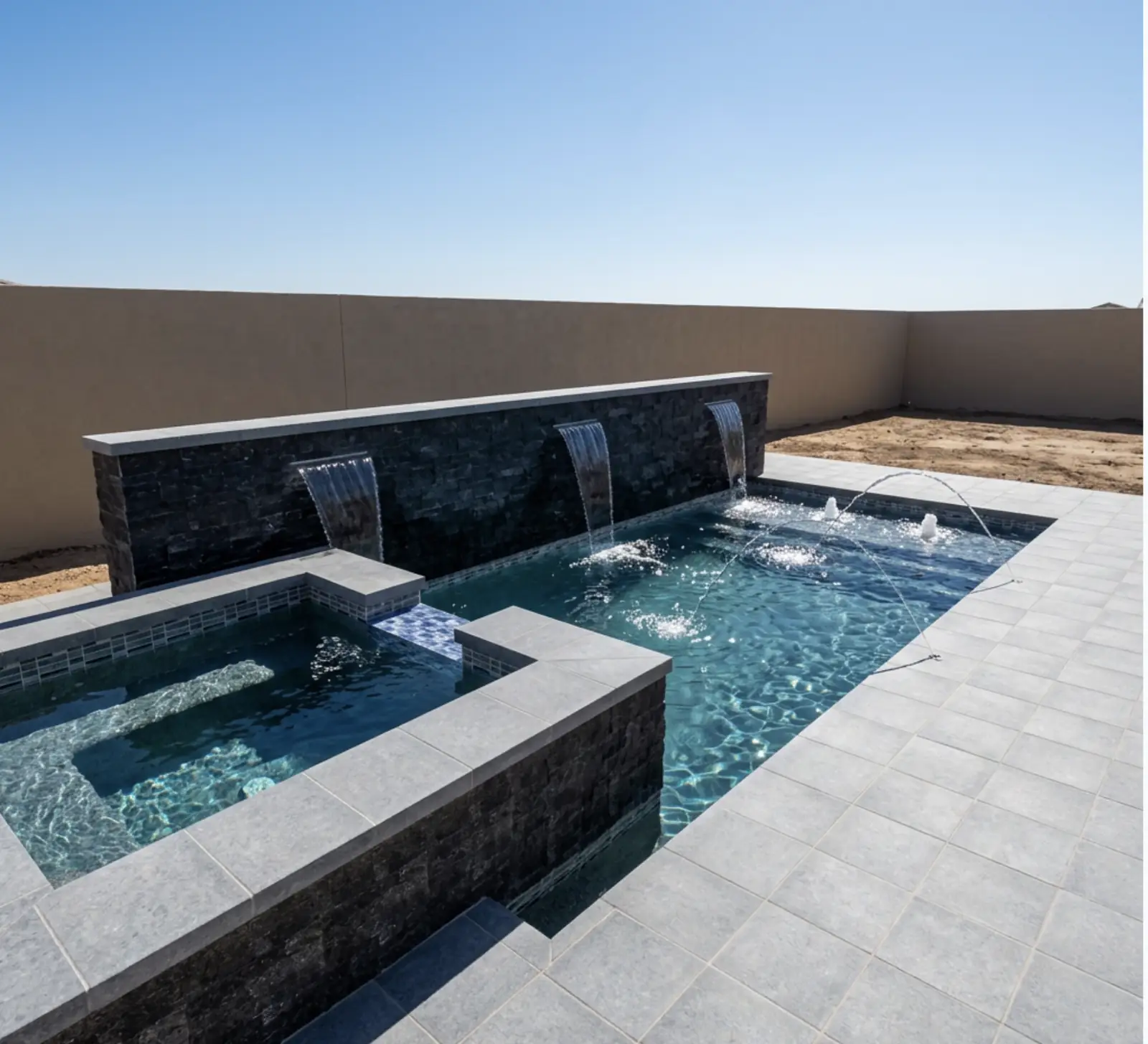
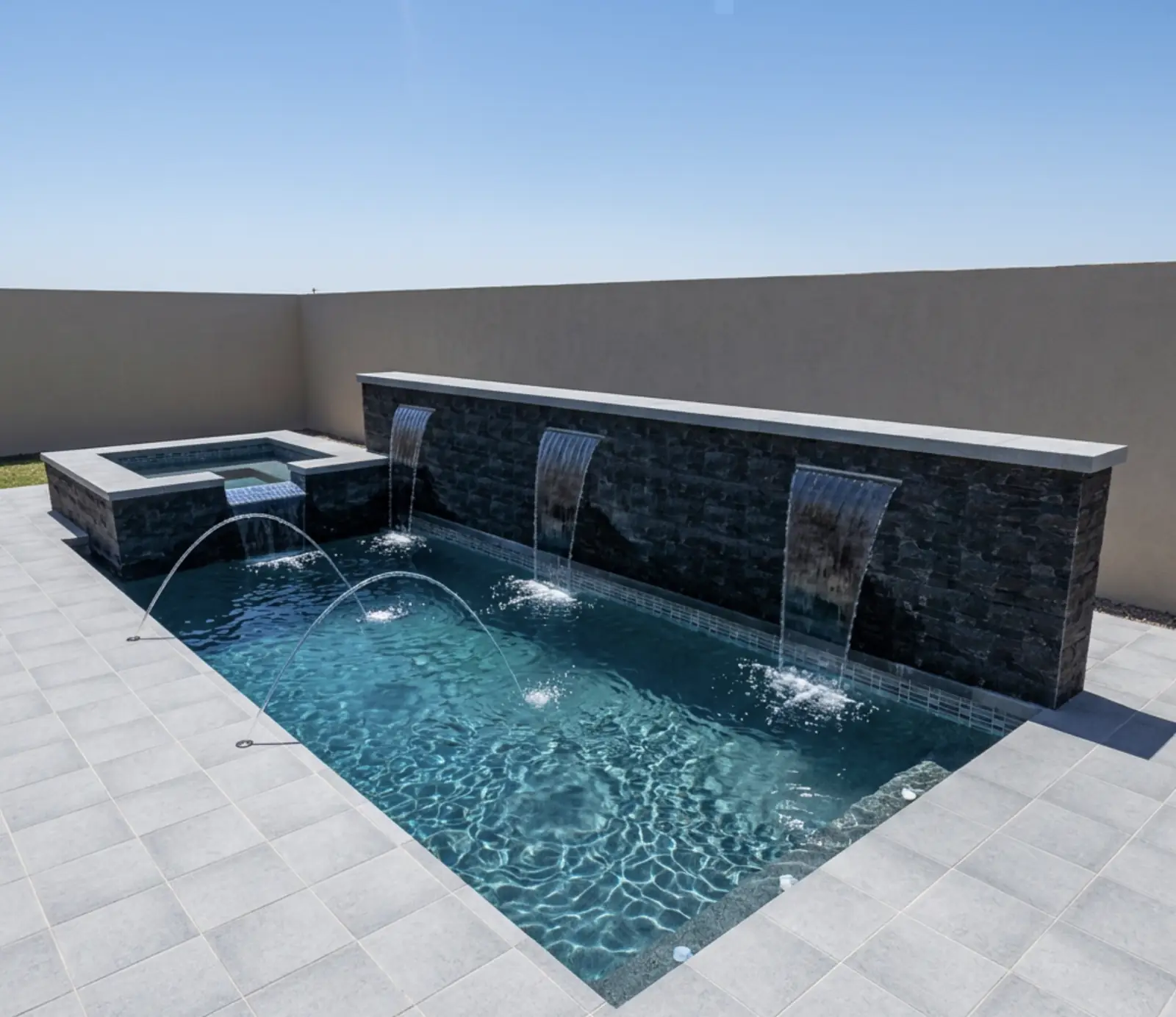
Photos do more selling than paragraphs. Show finished pools from several angles, plus a few in progress so homeowners see how you work. Label them with the pool type, finish and city if the homeowner agrees. That helps visitors find projects like theirs, and it gives your pages honest local content.
Ask the crew to take a few photos on every job. A phone is fine if the light is good and the shot is level. Before and after pairs are especially useful, because they show the yard changing.
7. Ask for referrals on purpose
Referrals are the oldest form of pool marketing, and many builders leave them to chance. Make it a step in your process. Ask at the end of the job, and again a few months later when the homeowner is enjoying the pool. Tell them what kind of project you are looking for, because "know anyone who wants a pool?" is vague and "a neighbor who has been thinking about one" is easy to answer.
You can also build relationships with landscapers, patio and fence companies, and builders of other trades. They meet homeowners with new yards and big plans. Refer work to them, and many will do the same.
8. Use paid ads carefully
Paid search can bring in homeowners who are searching right now. It can also burn money quickly. A few basics keep it under control.
- Start with a small daily budget and a tight service area.
- Send clicks to a page built for one purpose, not your home page.
- Add negative keywords so you do not pay for searches like "pool repair" or "pool jobs" if you only build.
- Track which ads produce calls and form submissions, not just clicks.
- Turn off what is not working and put the money into what is.
Paid ads make the most sense once your website can capture the visitors you pay for. Sending paid traffic to a weak site is the same leak, at a higher price.
9. Follow up fast, by phone, text and email
Speed matters because homeowners are often talking to two or three builders at once. Reply quickly, and make the reply useful. A message that includes their design or estimate is better than "thanks for your interest."
- Call or text as soon as a lead comes in.
- Send a short email that recaps what they designed and proposes a site visit time.
- Follow up a few days later if they have not replied, then again later with something new, like a recent project.
- Keep notes so anyone on your team can pick up the thread.
We wrote a full playbook in how to follow up on a pool lead, and a guide to sorting good leads from weak ones in how to qualify pool leads before the site visit.
Track what works
This is the tenth item hiding inside the nine, and it ties them together. If you do not know where inquiries come from, you cannot tell good marketing from busy marketing.
- Ask every new lead how they found you, and write it down.
- Use a tracking phone number or a separate form for paid ads, so you can tell them apart.
- Check Google Search Console and Google Business Profile insights monthly.
- Keep a simple sheet: date, source, name, outcome, job value if won.
- Review it every quarter and shift effort toward the sources that produce signed jobs.
Count signed jobs, not just inquiries. A source that sends many tire-kickers can look good until you see how few close.
Where to start: if you can only do three things this month, claim and complete your Google Business Profile, put a design and estimate tool on your site, and set up a simple way to ask for reviews. Those three affect nearly every homeowner who looks at you.
A simple 90-day plan
If the list feels long, here is one way to spread it out.
- Month one: fix your Google Business Profile, check your contact details across the web, and start asking for reviews.
- Month two: add or improve your website's calls to action, add a design and estimate tool, and upload your best photos.
- Month three: write a follow-up routine, set up simple tracking, and decide whether paid ads make sense given what you have learned.
Then keep going. Add one city page or one project write-up a month, and review your tracking sheet each quarter.
How QuickPoolQuote fits in
QuickPoolQuote is pool design software and pool quote software that runs on your own pool builder website. Plans start at $495 per month, or $4,752 per year with annual billing at 20% off, and include 100 leads per month. Extra leads come in packs of 50 for $199. There is no setup fee, and the tool is live in about 24 hours. See pricing for details, or read about instant pool quote software to see what homeowners experience.
Common questions
How much should a pool company spend on marketing?
There is no single right percentage, and we will not invent one. Start from your own numbers: what a job brings in, how many inquiries you need to close one, and how many jobs your crew can handle. Spend where you can measure results, and adjust every quarter.
What is the best way to market a pool company?
For most local builders, the foundation is a complete Google Business Profile, steady reviews and a website that gives visitors something to do. Paid ads, referrals and email build on that base. The best mix depends on your area and your capacity.
Do I need social media?
It helps as a place to show finished work and build familiarity, but it is not required to get started. If you have limited time, put it after your Google profile, reviews and website.
How long does it take to see results?
Some things work in days, such as faster follow-up or a better call to action. Search and reviews build over months. Expect the slower channels to pay off later, and keep adding to them.
How do I try an instant quote tool?
Visit get started, call 480-602-1192, or browse the help center. If you do not have a site yet, see the free pool builder website page.
See it on your own website
Pool design software, with a price from your pricing, live in 24 hours.
More from the blog
Put design software on your website this week.
Homeowners who design their pool and see a price call you ready to build. Tiers start at $495 a month with no setup fee. See pricing